
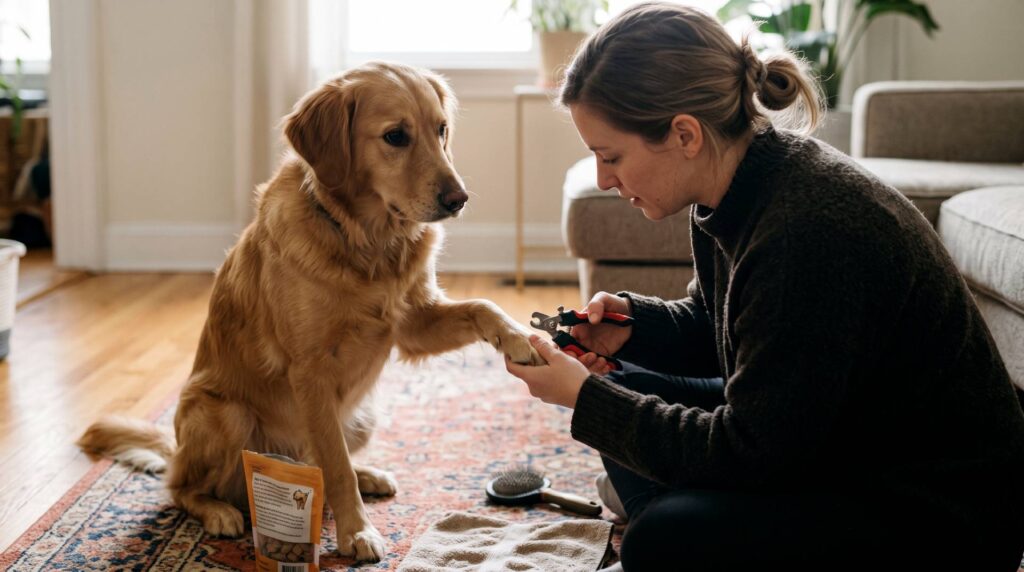
If you can hear your dog coming before you see them — that familiar click, click, click across the kitchen tile — it’s probably time for a nail trim.
Nail care is one of the most overlooked parts of grooming. Yet it affects how your dog stands, walks, and plays every single day. Here at Bark Club Dog Spa in Cutler Bay, it’s one of the questions we hear most: how often should I actually be trimming my dog’s nails?
Quick answer
Most dogs need their nails trimmed every 3 to 4 weeks. Very active dogs that walk on pavement daily may stretch to 6 weeks, since concrete files nails down naturally. Small breeds, seniors, and indoor dogs often need a trim every 2 to 3 weeks. A simple rule: if your dog’s nails touch the floor when they stand still, they’re due.
Why nail length matters more than you think
Long nails aren’t just a cosmetic issue. When a nail is too long, it hits the ground before the paw pad does. That pushes the toe joints back and forces your dog to shift their weight onto their heels.
Over weeks and months, that small change adds up:
- Posture and joints. Dogs compensate by changing how they stand, which can strain wrists, elbows, hips, and the back — especially in seniors and large breeds.
- Traction. Long nails reduce grip, so dogs slip more easily on smooth floors.
- Pain and injury. Overgrown nails can split, crack, snag on carpet, or tear — and a torn nail bleeds and hurts.
- Curling nails. Left long enough, nails (and dewclaws in particular) can curl back into the paw pad.
Regular trims keep your dog comfortable and moving naturally. They also make each session faster and easier, because the nail never gets far out of control.
How often to trim dog nails: it depends on your dog
There’s no single schedule for every dog. Nails grow at different rates, and how much they wear down depends on where your dog spends their day. Use this as a starting point:
| Your dog | Typical trim schedule | Why |
|---|---|---|
| Small breeds (Chihuahua, Yorkie, Shih Tzu, Maltese) | Every 2–3 weeks | Light body weight means less natural wear |
| Senior dogs | Every 2–3 weeks | Less activity, and nails often grow thicker with age |
| Mostly indoor dogs, or dogs walked on grass | Every 3–4 weeks | Grass and indoor floors barely file nails down |
| Medium and large breeds with average activity | Every 3–4 weeks | The most common schedule we see |
| Very active dogs on sidewalks daily | Every 4–6 weeks | Concrete works like a natural nail file |
| Puppies | Every 1–2 weeks | Fast growth, plus it builds comfort with handling early |
Don’t forget the dewclaws — the small nails on the inner side of the leg. They never touch the ground, so they never wear down. Many dogs need them checked at every trim, even when the other nails look fine.
How short should you cut your dog’s nails?
The goal is a nail that sits just above the floor when your dog is standing. To get there safely, you need to understand the quick.
The quick is the living part inside the nail. It holds blood vessels and nerves. Cutting into it is painful and causes bleeding. It’s also the main reason so many dogs learn to fear nail trims.
- On light or white nails, the quick shows as a pink area inside the nail. Trim about 2 mm in front of the pink.
- On dark or black nails, you can’t see the quick. Trim tiny slivers at a time. When the cut surface shows a small grey or dark dot in the center, stop — the quick is right behind it.
Here’s something many owners don’t know: the quick grows with the nail. If nails are left long, the quick extends too, so you can’t cut them short in one session. Frequent, small trims encourage the quick to recede gradually. That’s the safest way to bring overgrown nails back to a healthy length.
6 signs your dog’s nails are too long
- You hear clicking on hard floors when your dog walks.
- Nails touch the ground while your dog is standing still.
- Your dog slips or splays their toes on smooth surfaces.
- Toes look twisted or pushed sideways.
- Your dog licks or chews at their paws, or pulls away when you touch their feet.
- Dewclaws are curling toward the leg or paw pad.
If you notice a nail that is cracked, bleeding, or growing into the pad, call your veterinarian before booking a grooming appointment.
Nail care for Cutler Bay dogs: what’s different here
Living in South Miami-Dade changes the nail-care equation in a few ways:
- Tile and terrazzo floors. Many homes in Cutler Bay, Palmetto Bay, and Homestead have tile, terrazzo, or polished concrete. These floors are slippery for dogs with long nails, and they make the clicking impossible to miss. Short nails mean better grip and fewer slips indoors.
- Hot pavement means more grass walks. During our long, hot months, many owners move walks to early mornings or grassy areas to protect paw pads. That’s the right call — but grass doesn’t wear nails down like concrete does. If your routine shifted this summer, your dog’s nails may be growing faster than you expect.
- Humidity and paw health. Moisture trapped between toes is a common issue in our South Florida climate. Keeping nails short and the hair between the pads trimmed lets paws dry faster and stay cleaner.
Trimming at home vs. professional nail trims
Many owners trim at home between grooming visits, and that’s great. If you do, use sharp clippers or a grinder made for dogs, work in good light, keep styptic powder nearby, and reward your dog after every paw.
But for many dogs, nail trims are the most stressful part of grooming. Dark nails, wiggly puppies, anxious rescues, and seniors with sore joints are all harder to trim safely at home. That’s where a professional makes the difference.
How we handle nail trims at Bark Club Dog Spa
At Bark Club, nail care follows the same philosophy as everything we do: calm, patient, and cage-free. Our professional nail trims are built around your dog’s comfort:
- We go slow with dark nails, taking small cuts and checking each nail so we never rush into the quick.
- We use gentle handling and support older dogs in comfortable positions that don’t strain their joints.
- We take breaks when a dog needs one. A trim done in two calm steps beats one rushed, stressful session.
- We check dewclaws and paw pads every time, and let you know if anything looks off.
Nail trims are included with our full grooming services and also available on their own, so you can keep a steady schedule between full grooms.
Hear the clicking again? Book a nail trim or full groom at Bark Club Dog Spa in Cutler Bay, or call us at (305) 969-4700. Your dog’s paws — and your floors — will thank you.
Frequently asked questions
How often should dog nails be trimmed? Most dogs need a trim every 3 to 4 weeks. Small breeds, seniors, and puppies often need one every 1 to 3 weeks. Very active dogs that walk on pavement daily may go 4 to 6 weeks.
How do I know if my dog’s nails are too long? If the nails touch the floor while your dog stands, or you hear clicking on tile, they’re too long.
What happens if I cut the quick? The nail will bleed and your dog will feel pain. Apply styptic powder or cornstarch with gentle pressure until the bleeding stops. If it doesn’t stop within a few minutes, call your vet.
Is grinding better than clipping? Both work. Grinders give a smoother edge and make it easier to avoid the quick on dark nails. Some dogs dislike the noise and vibration, so we choose the method that keeps each dog calm.
Can I just let walks wear my dog’s nails down? Only if your dog walks on concrete a lot. Grass, sand, and indoor floors don’t file nails enough, and dewclaws never wear down at all.
Do you offer nail trims without a full groom in Cutler Bay? Yes. At Bark Club Dog Spa you can book a nail trim on its own to keep your dog on schedule between full grooming visits.